
New wine in an old bottle
NeuralPOM: A Hybrid Ocean Forecast Model with Differentiable Dynamics and Staged Learning
Ruiqi Shu · Guangliang Liu · Ruijian Gou · Tianrun Gao · Haomin Wen · Hao Li · Xiaomeng Huang
arXiv:2611.02460 ↗ · Read the PDF ↗ · Supplement ↗ · Numerical source tables ↗
The scientific question
A coarse ocean model misses parts of the resolved evolution of a finer reference model. A learned endpoint correction can reduce local error, but its effect is then carried through pressure gradients, advection, and mixing. The paper examines how differentiable dynamics, staged learning, and constrained corrections shape that subsequent evolution. (Manuscript, Sections 1–2.)
The reference ocean
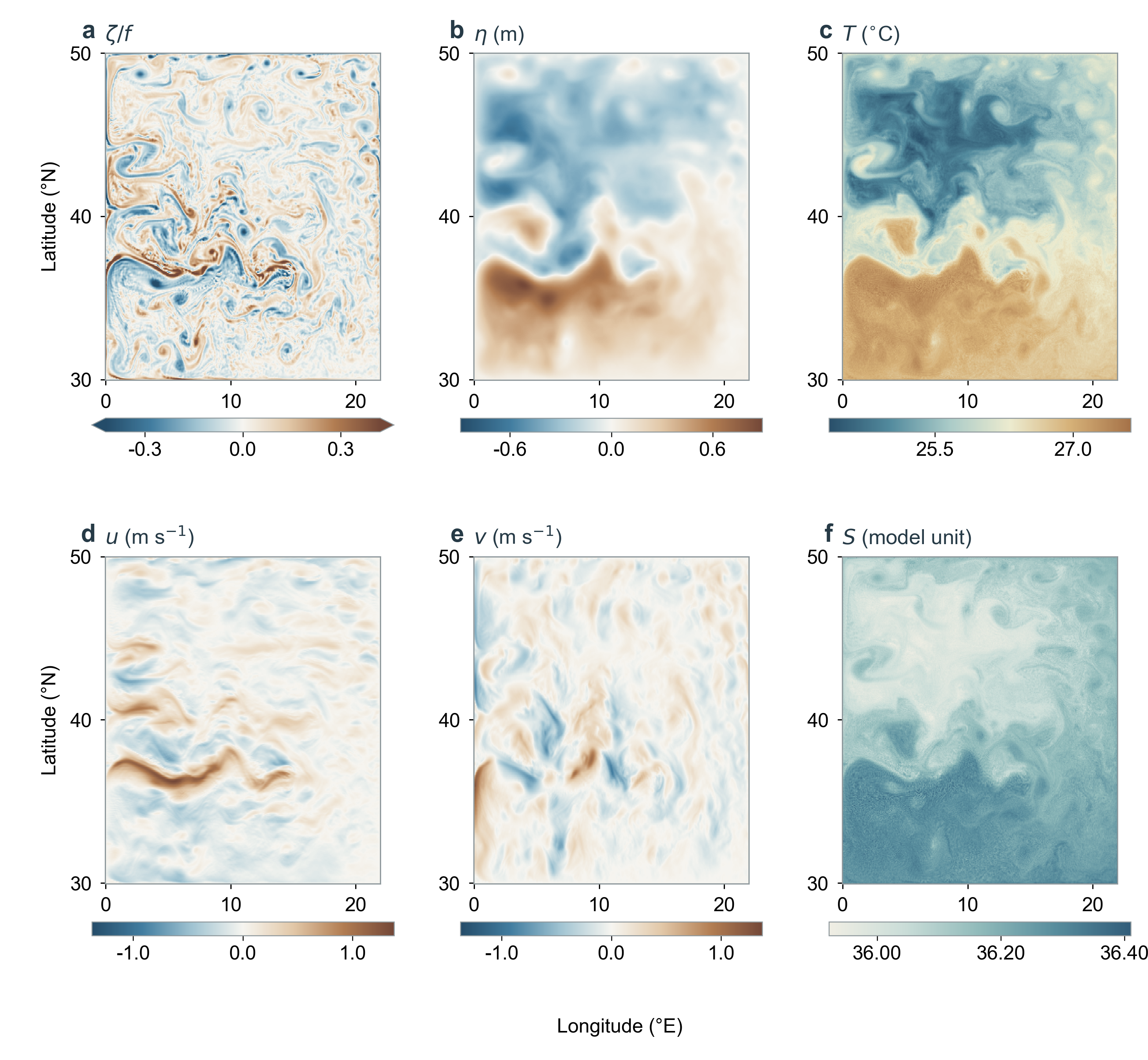
The primary experiment is a wind-driven double gyre. Each physical core has its own eight-member fine-grid reference ensemble, restricted consistently to the coarse forecast grid. The fine horizontal grid is 354 × 322, and the coarse grid is 90 × 82, with 15 active vertical layers. (Manuscript, Section 3.1.)
Three parts of the method
| Part | Question it answers | Tutorial |
|---|---|---|
| Differentiable physics | How does an earlier correction change a later state? | Physical framework, adjoint solve |
| Staged learning | Which states and gradient paths train the network? | Pretrain → Midtrain → Posttrain |
| Constrained correction and DND | Which budgets and density responses should the update preserve or attenuate? | Correction, DND explorer |
Density response and forecast error
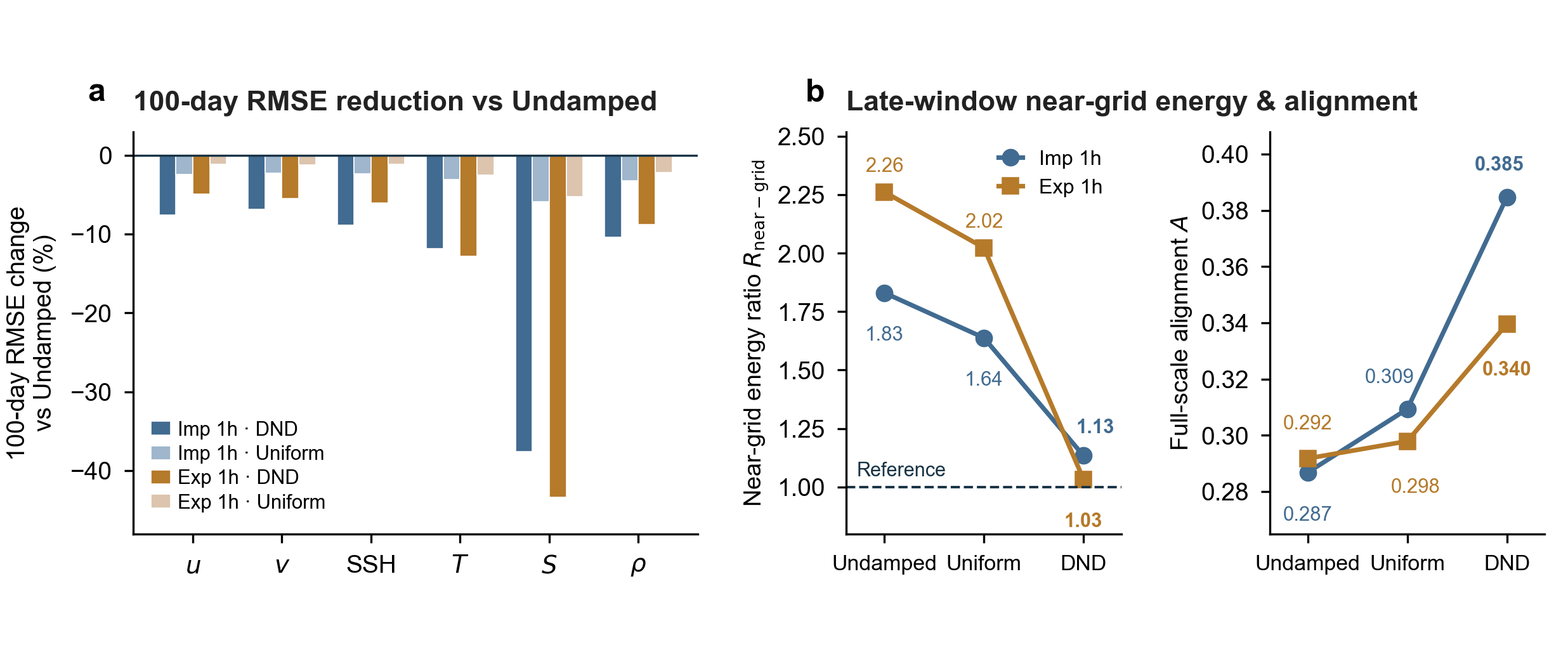
For hourly coupling, the paper reports DND reductions relative to the same-weight Undamped update of roughly 5%–9% in zonal velocity and SSH error, 12%–13% in temperature, 38%–43% in salinity, and 9%–10% in density across the two physical cores. These are the paper's reported error comparisons; the projection's 43.75% squared-norm reduction follows separately from its retention factor. (Manuscript, Section 5.2.)
Read a forecast comparison correctly
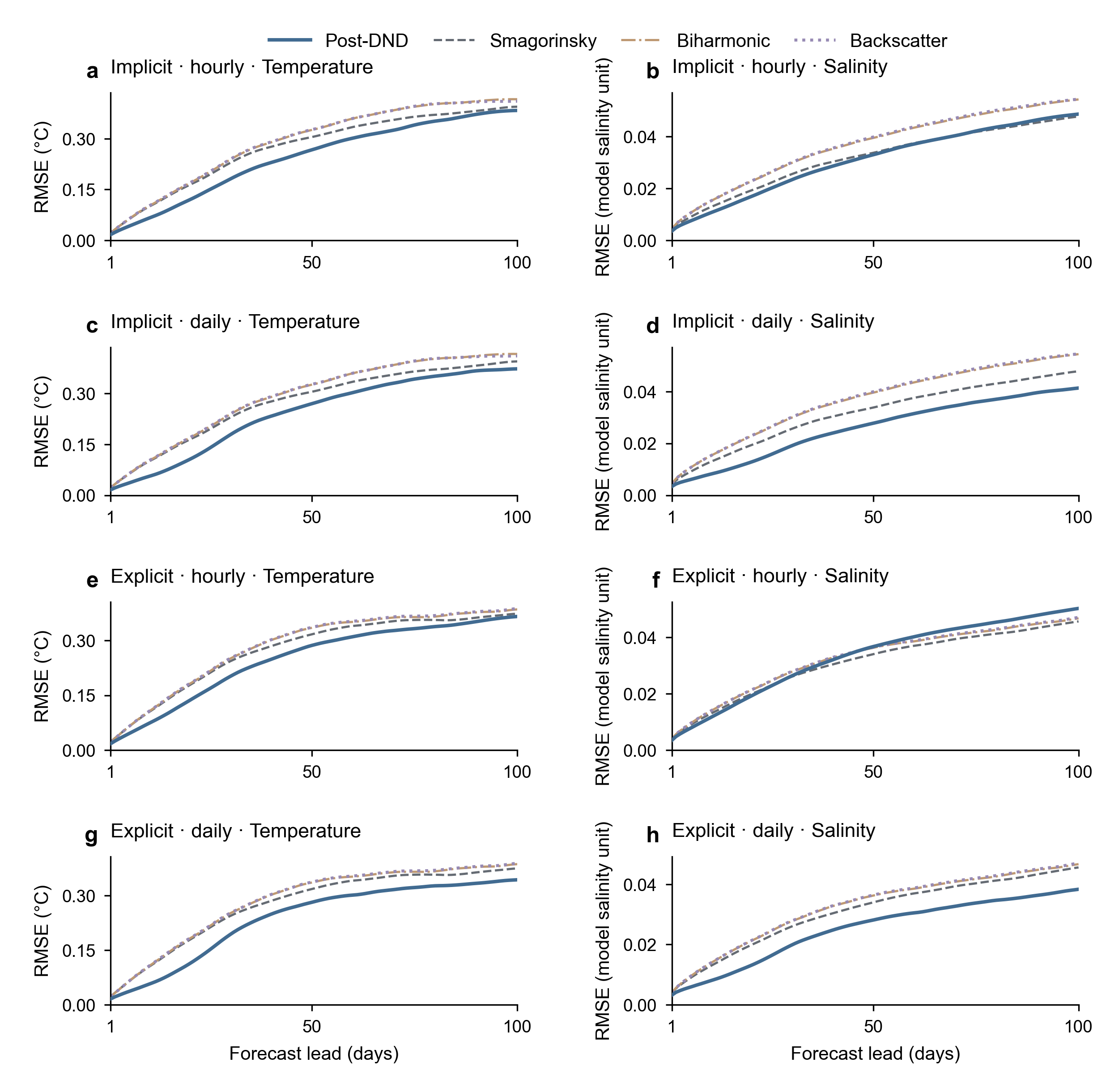
The paired protocol uses 16 forecast origins and 100-day trajectories, initialized from reference member 7 at model days
For a specific comparison, match the physical core, correction interval, initial state, variable, spatial weighting, and lead-time window. The reproduction guide maps the saved source tables and evaluation commands to these choices.
Trace the paper to the repository
| Evidence or method | Repository location |
|---|---|
| Model architecture | models/corrector_net.py |
| State constraints | hybrid/sparse_coupling.py |
| Training stages | v1/engine.py |
| Density-normal policy | evaluation/density.py |
| Forecast protocol | configs/examples/evaluation_100d.json |
| Forecast and stage metrics | paper/data/ |
Authors and availability
Ruiqi Shu, Guangliang Liu, and Ruijian Gou contributed equally, in this author order.
The repository README and manuscript contain the full author affiliations. Corresponding authors are Hao Li (lihao_lh@fudan.edu.cn) and Xiaomeng Huang (hxm@tsinghua.edu.cn).
Code is available on GitHub under Apache-2.0. Data are hosted in the NeuralPOM ModelScope repository. See its dataset documentation for available assets and access.