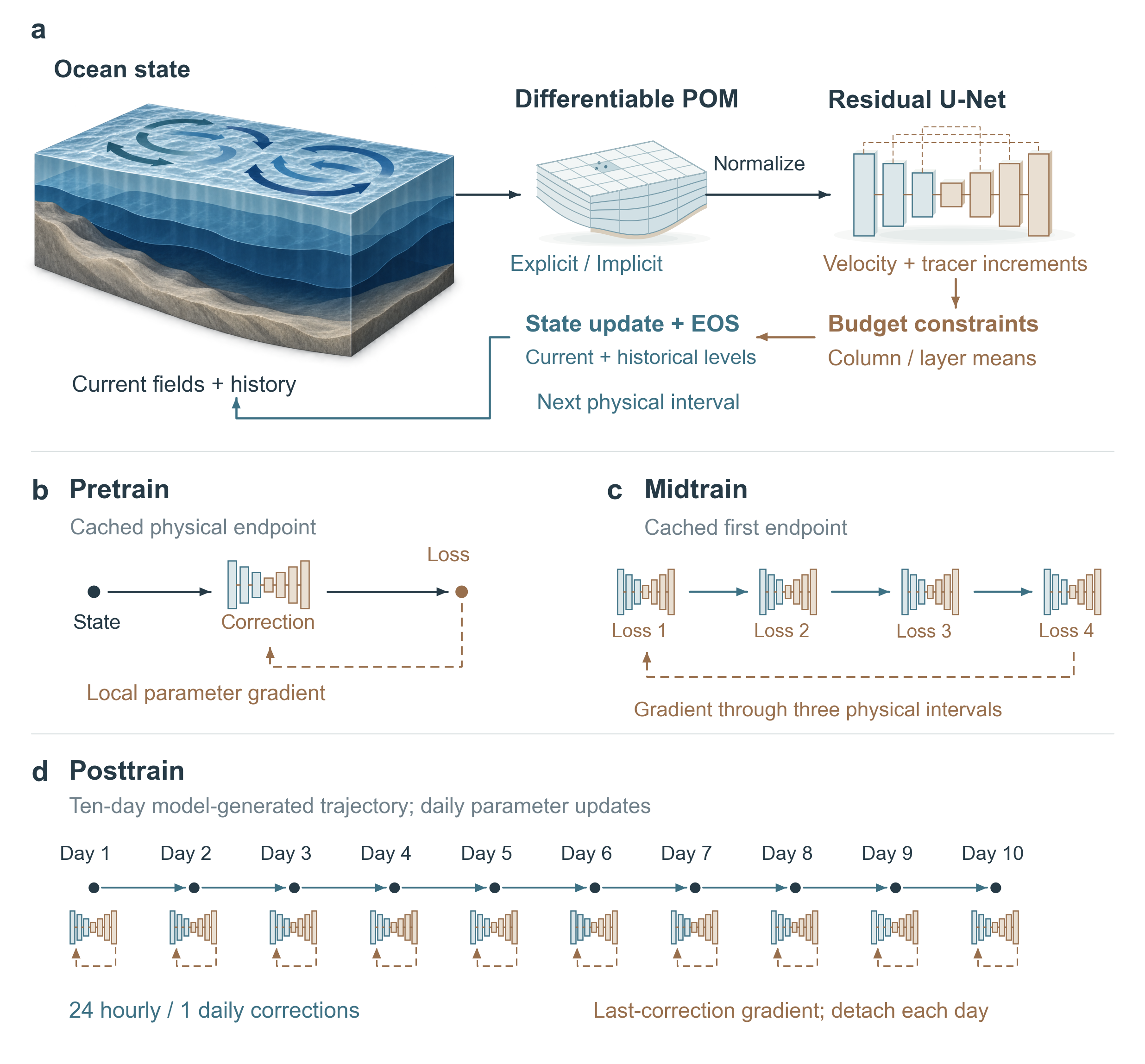
Learning inside an ocean trajectory
The physical model remains responsible for advancing the ocean. NeuralPOM learns endpoint increments in velocity, temperature, and salinity and applies them through constraints that preserve the model's transport and tracer budgets. The next physical interval starts from this corrected numerical state. (Manuscript, Section 2.2)
One forecast cycle
Let
The published configurations use
What the correction preserves
For active vertical layer
The velocity constraints let the network change vertical shear while keeping the depth-integrated transport under the physical external-mode equations. The tracer constraints redistribute heat and salt horizontally within a layer without adding a net layer source.
A common limiting factor for each variable pair caps standardized increments while preserving these zero-mean constraints. The same increment is added to the current and backward leapfrog fields. Density is then refreshed from the nonlinear equation of state. Sea-surface elevation, turbulence variables, and other physical fields evolve during the next physical integration. (Correction implementation)
From architecture to deployment
| Component | Scientific role | Read next |
|---|---|---|
| Residual U-Net | Predict endpoint increments from standardized physical fields | CorrectorNet |
| Staged optimization | Learn endpoint accuracy and the consequences of corrections | Training |
| Density-normal damping | Attenuate the constrained density-modifying tracer projection at inference | DND |
| Frozen forecast | Advance corrected states with fixed network weights | Reproduction |